Dappled Light - What Is Means and How to Use It in Painting
Dappled lite refers to that spotted lite which typically comes through gaps in a tree canopy. Below is a great example by Claude Monet—detect the spots of lite orange amidst the dark purple shadows.

Claude Monet, Garden Path, 1901
The shapes created by the dappled light vary based on:
- The position of the sunday;
- The height of the tree canopy;
- The shapes of the gaps which light is coming through (which tend to modify frequently with the wind); and
- The plane where the low-cal is hit.
The shapes are as well elliptical in nature, meaning they elongate every bit they get farther into the altitude.
Below is a photo of what dappled calorie-free looks like in life, along with a close-upward. This was taken on a clear solar day, tardily in the morning. Warm, dappled light was shooting through the gaps in the leaves on the right-hand side.

Another important observation is the soft gradation between light and shadow. You lot can see this clearly in the close-upward below.

More Examples of Dappled Lite
Below are some more than examples, starting with another painting by Claude Monet featuring dumbo trees and dappled calorie-free striking the rough ground. In this case, Monet appears to have scumbled thick and saturated color over a night foundation of greens and reds. Also, notice how the dappled lite roughly follows the profile in the country.

Claude Monet, The Olive Grove in the Moreno Garden, 1884
Ilya Repin's, Alley in the Park, Kachanivka, is a not bad example of using dappled light to link two areas: the shadowed path under the tree canopy and the calorie-free area in the distance behind the person. Notice how the color used for the dappled lite on the path is the same as the color used in the light expanse. As well notice how the clusters of dappled light get smaller every bit information technology moves into the distance, adding a sense of perspective to the painting.

Ilya Repin, Alley in the Park, Kachanivka, 1880
My written report below of Mountain Barney is another case of using dappled light to link two areas: the shadowed path and the loftier-fundamental groundwork.
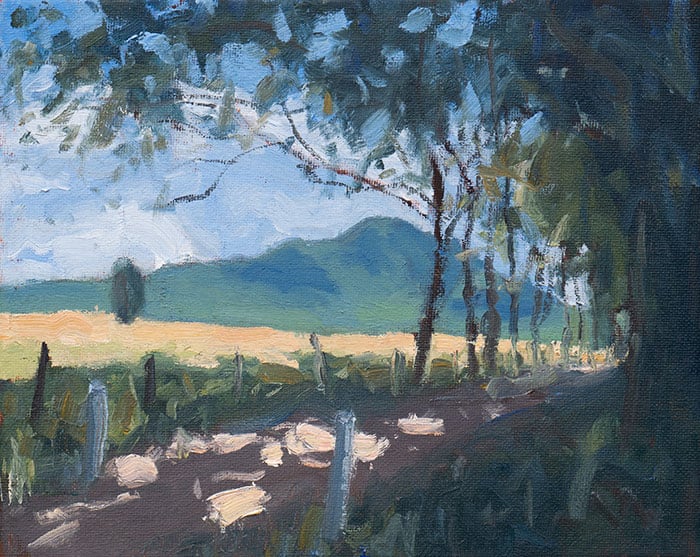
Mt Barney Report, Oil, 10x12 Inches, Oct 2018
The painting beneath by Isaac Levitan features dappled light on long, irregular grass. Notice how some tall strands of grass and flowers are picking upward light and appear to exist intruding on the shadows. This creates an interesting and subtle overlap between light and shadow.
Tip: If you are creating an overlap between light and shadow similar Levitan did below, make sure you don't overdo it. Otherwise, yous risk compromising the integrity of your shadows.
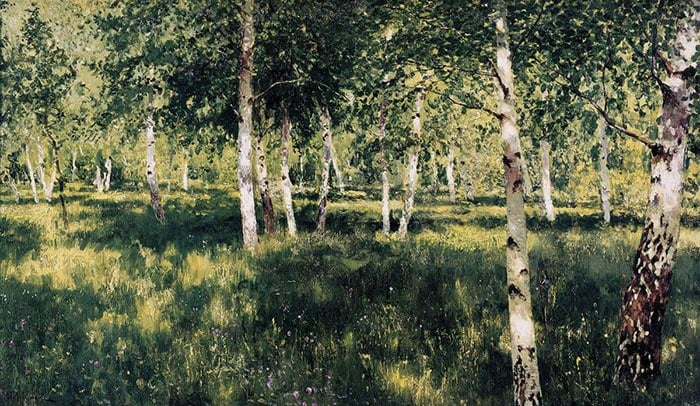
Isaac Levitan, Birch Grove, 1889
Below is an example of dappled light painted with watercolors by John Vocalizer Sargent, appropriately namedCorfu. Lite and Shadows. An important observation is how Sargent used dissimilar colors for the shadows for each plane of the building: light purple/blueish for the verticle plane on the right-hand side, warm regal for the left aeroplane, and rich blue for the top aeroplane.

John Vocalist Sargent, Corfu. Low-cal and Shadows, 1909
Birthday Teacher (beneath) features a remarkably complex scene depicting a teacher and students having forenoon tea, all basked under dappled light.

Nikolay Petrovich Bogdanov-Belsky, Altogether Teacher, 1920
The painting below is much calmer in comparison to Birthday Instructor to a higher place. It depicts two ladies sitting at the table, amongst the buildings and nature. Warm, dappled light is scattered throughout the scene. Observe the warm/cool human relationship between the dappled light and shadow.
Tip: A useful exercise when analyzing paintings is to consider where the main light source is coming from (being the sun in this painting). In this case, the sun seems to be overhead to the right, possibly behind the creative person. This is because the low-cal is hit the correct-hand side of the tree. The dappled light which is striking the wall as well appears to be slanting upward to the right, suggesting the position of the sun.

Sergey Arsenievich Vinogradov, In the Summer, 1908
Tips for Using Dappled Light in Your Paintings
Here are some general tips for using dappled light in your paintings:
- If you want to paint realistically, and so try picking up the gradual shift between light and nighttime.
- It tin exist highly constructive to dissimilarity thick paint and warm colors for the dappled light against thin paint and cool colors for the shadows. This creates a hit contrast between calorie-free and night.
- Get out your colors slightly unmixed on your brush when painting dappled light. This will give your strokes an interesting multicolored effect which mimics the appearance of light in nature.
(You might exist interested in my Painting Academy course. I go into more item on what colour is and how to apply it finer in painting.)
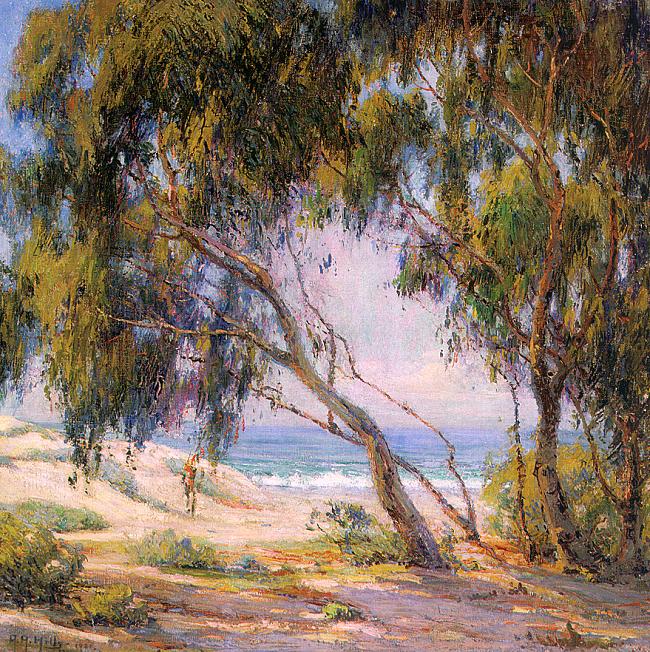
Anna Althea Hills, Body of water View
biddlecombethonse.blogspot.com
Source: https://drawpaintacademy.com/dappled-light/
0 Response to "Dappled Light - What Is Means and How to Use It in Painting"
Post a Comment